
By Peter Kahindi

THE TENTH of August 2026 should be considered historical for Ugandans of Generations Z and Alpha.
On that day, a letter circulated online – especially in Ugandan circles – appearing to have been authored by the Jinja-based Law Firm of Okalang Law Chambers.
The contents were brief, entertaining and shocking; this time-tested Firm was communicating to the Law Development Centre that it was not in position to take on a Clerkship program student, and explained why:
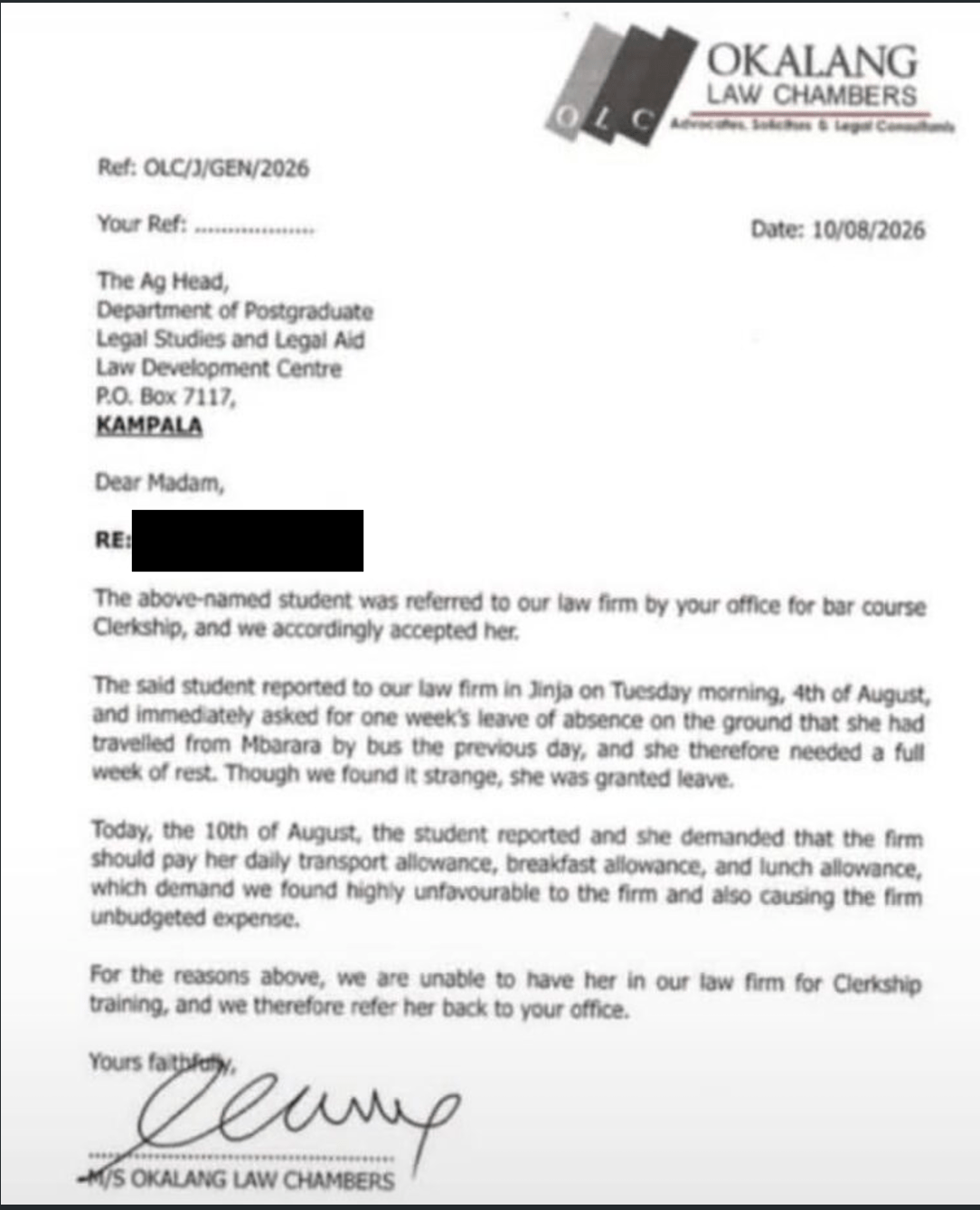
The Firm stated that the student had not only asked for one week’s rest after travelling from Mbarara to Jinja to take up the assignment, but had also demanded for breakfast, lunch and transport allowances as part of her conditions for the Clerkship program.
The Firm concluded that this was outside the Firm’s expenditure budget and therefore turned her down.
They did not state the other obvious sentiments in their minds arising from her behaviour.
The letter went viral, as if we are starved of humour in this country.
The reactions were varied, including those insisting that breakfast, lunch and transport allowances were – to a young lawyer – entitlements that should be treated as “bare minimums”.
Some said the Law Firm was simply out to frustrate the student’s efforts in her academic pursuits, and other similarly colourful commentaries generally vilified senior lawyers for being mean.
Let’s go back to basics.
The Cambridge English Dictionary defines the term entitlement as “something that you have a right to do or have, or the right to do or have something” or in the alternative, “the feeling that you have the right to do or have what you want without having to work for it or deserve it, just because of who you are.”
In other words, there are certain rights and benefits that one is entitled to, given a specific set of circumstances.
By virtue of the profession, lawyers are expected to steer clear of emotions and attempt to analyse situations based on hard facts.
My understanding of Clerkship, as far as I can recall, is that it is part of the academic program at the Law Development Centre (LDC).
Typically, the Centre makes letters of introduction of a student to the establishment which has agreed to take on that student.
It is important to take note of the contents of the introduction.
There is an acknowledgment that the student is indeed pursuing the post-graduate diploma at the Centre and is due for Clerkship.
To my knowledge, which may be limited, in this case there is no introduction that spells out that the student will be entitled to any remuneration, facilitation, or allowance.
Clerkship, as I stated above, is a continuation of the LDC curriculum. That is why students are eventually supervised and assessed by the professional institution that manages this stage of education.
Clerkship programs are therefore not employment opportunities, where some remuneration or benefit would naturally arise, commensurate with the services offered by an employee.
I will not define “an employee” here.
Clerkship placements in private chambers are a learning opportunity bestowed upon the student, and not a duty or burden that the Law Firm should have to shoulder.
As I said, let’s go to the basics.
A student should be grateful that a learning opportunity has been presented to them as part of their path to attaining the academic credentials that will allow them to join the profession.
All that being said, however, a typical Law Firm in Uganda will provide breakfast, lunch and weekly transport facilitation for Clerkship students.
Not all of them do so, understandably, for reasons that even some families we (including students) hail from don’t.
There are even Firms that publicly welcome their Clerkship students with a proud acknowledgement that presumably makes them appreciate the learning opportunity.
Law Firms make these announcements, provide allowances, et al, as a matter of professional courtesy and not a contractual or even statutory obligation.
A clear, bold line between the two should be drawn, understood and appreciated all round.
Clerkship programs are also potential vetting processes for employment.
A student who stands out could get hired immediately after their LDC academic program – putting them far ahead of the pack.
It has happened often, and we have a great many serious lawyers in the field who can attest to this with professional (and financial) pride.
Demanding lunch and transport at the start of one’s Clerkship in the manner the August 10th letter indicated was a bad career move.
Even on a personal note, it has never been a good way to start a serious relationship.
Young people are known to be firmly outspoken and assertive about their rights and entitlements, which is why Gen Z and Gen Alpha need to sit up and pay attention.
Being outspoken and assertive is commendable. We encourage it – especially for lawyers.
These are qualities that help ensure that rights and entitlements are not swept under the carpet.
In fact, with the trends in the corporate world, being outspoken means one will seek out and take on more opportunities, negotiate better and generally not be bullied by what life will inevitably throw at you.
But remember, oh you promising generations, what falls within the bracket of “entitlements”.
Do not get misled into seeing entitlements where there are none.
Those are what we call misplaced entitlements and could lead you to stray from the path of a promising career (legal or otherwise) into the quagmire of being a social media meme forever.
Okalang Law Chambers is teaching many young people a serious lesson: Do not get misled into seeing entitlements where there are none.
Indeed, for these young generations entitlement in itself is a quagmire. We must pull them out of it or, better still, try out best to keep them on the paths that save them from falling into it.





Jambo (Hi)! I'd be happy to hear your thoughts so…say something here?