
By Peter Kahindi

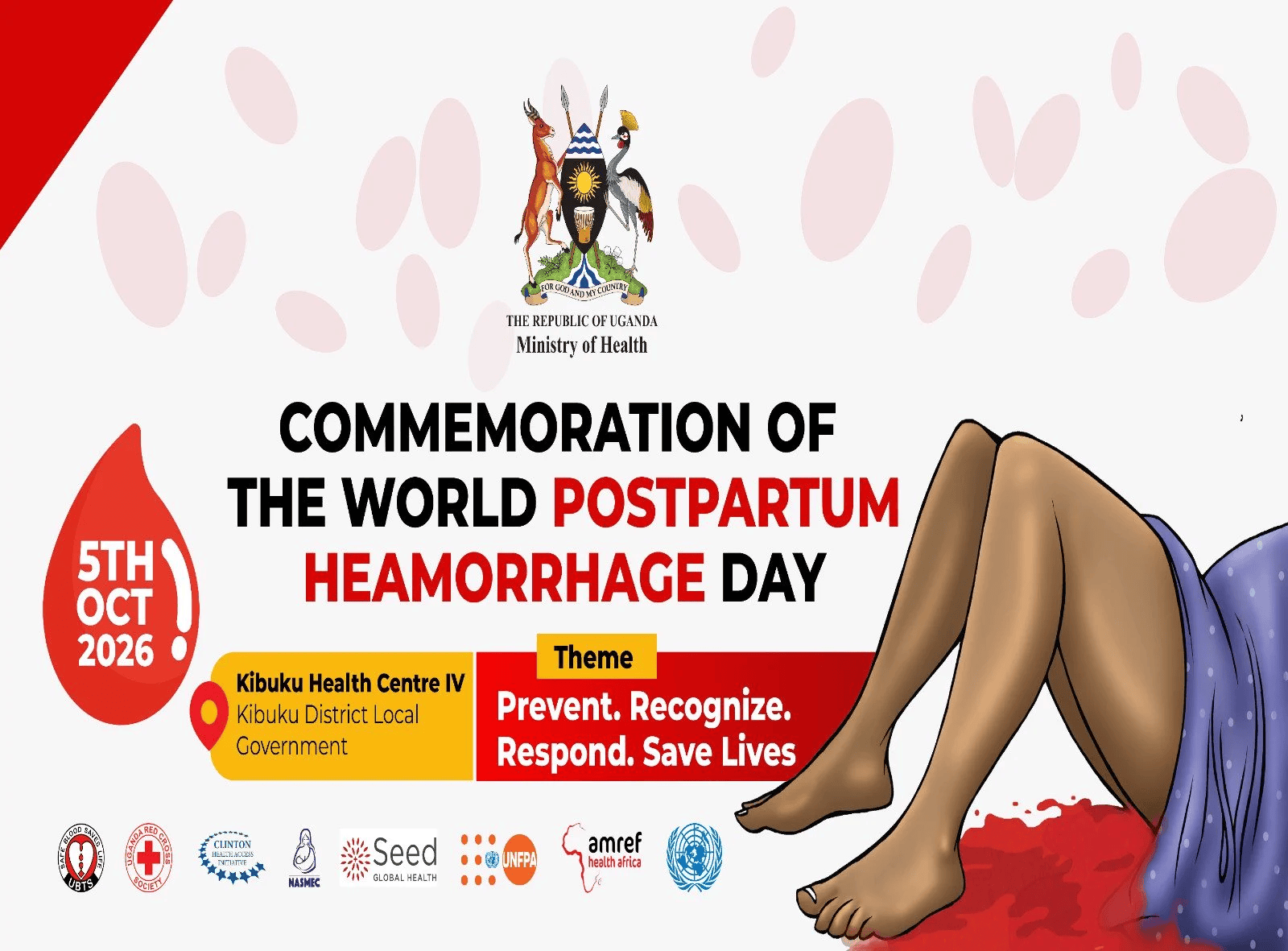
THE WORLD has started recognising October 5th annually as World Postpartum Haemorrhage Day.
Postpartum Haemorrhage (PPH) is the excessive bleeding of a woman after childbirth.
Consider this: PPH accounts for nearly 50% of all maternal deaths in Uganda. Meanwhile, 76% of those mothers who die in the process are aged 25 years and above.
There is a very high likelihood that you, dear reader, are affected by this statistic, in one way or another.
But our reflection today goes beyond PPH on its own to the urgent need for every Ugandan to make it a regular habit to donate blood.
The fact is, somewhere in Uganda today, a mother will bleed after childbirth, a child with severe malaria will grow dangerously ill, and a boda boda rider will be carried into a casualty ward after a crash.
Whether each of them lives may depend on a single question: is there blood on the shelf?
Too often, the answer is NO.
Uganda is projected to need about 450,000 units of blood a year, but collects only about 300,000, a deficit of roughly 150,000 units.
That is not an abstract statistic.
The Uganda Blood Transfusion Service (UBTS) says about 10 percent of Ugandans who urgently need blood do not get it because supply too often falls short.
In a country of our size, that means thousands of people each year, each of them somebody’s child, sister or father…. or you, reading this.
Blood is not a luxury. It is a daily necessity for the most ordinary emergencies of Ugandan life.
According to some sources, women with pregnancy-related complications account for about 30 percent of demand, while surgery patients, trauma victims, and people with cancer or sickle cell disease share a further 20 percent.
Children under five, fighting anaemia from severe malaria and malnutrition, need about half of all the blood used.
In other words, the people who depend most on donated blood are mothers and small children. If you have a mother, a wife, a sister, a daughter or a child, this is YOUR responsibility.
Here is something additional that I hope will make us uncomfortable, get us thinking, and move us into action as blood donors: Uganda’s blood supply rests largely on schoolchildren. Pupils and students contribute about 80 percent of the blood supplied to health facilities, and when schools close for holidays, hospitals across the country face acute shortages.
Think about what this means.
We have built a national lifeline on teenagers, then act surprised when it runs dry during school holidays.
Adults have left the work of saving lives to their children.
What a shame!
We are, however, alive to the fact that moral appeals alone will not close the 150,000-unit gap. We need systems that make regular giving easy, normal and trusted.
We can try out a few of the options proposed here:
Employers Should Take Charge: From banks and ministries to factories and telecoms, they should host drives on a fixed quarterly calendar and give staff time off to donate.
Corporate bodies have already shown it works and is achievable. For instance, the National Social Security Fund came up with a drive targeting 8,000 units, translating into 24,000 health interventions.
That goal should be a regular rhythm, not an annual stunt.
Harness the power of Groups and Associations: Just before the COVID-19 lockdown, the Non Resident Nepali Association in Kampala signed an agreement with UBTS to mobilise its members to donate at least twice a year.
Churches, mosques, SACCOs, market associations, boda boda stages, sports clubs, Rotary and Lions groups and cultural institutions can do the same.
A pledge made as a group is far easier to keep than one made as an individual.
Let us find the donors where they are: Everything is about what makes it convenient for people nowadays. Collection teams have set up in Kampala at Mukwano Arcade and the Kiseka, Kawempe and Nakawa markets.
More mobile units in trading centres, taxi parks, universities, churches and mosques, especially in upcountry districts, would remove the biggest excuse of all – distance.
Create the beautiful culture of regular donation: The goal is not to make it a one-off act of heroism but to create a habit that saves lives.
Donor cards, SMS reminders when you are eligible again, recognition certificates and a simple donor app would turn goodwill into a dependable supply. As my friend Paul Kaheru recently mentioned, donor who gives twice a year is worth far more than ten who give once and are never seen again.
To deal with the mostly unfounded suspicions, build trust through transparency: We should, for instance, publish regional stock levels openly, perhaps with a public dashboard and radio updates, and show where donated blood goes.
Let donors see that their gift reached a mother in labour and not a black market. Trust is the most valuable infrastructure a blood service can have.
Tap into celebrities and personalities with big social media followings: Musicians, footballers, comedians, pastors, imams, MPs and radio presenters should donate publicly and regularly, and say why.
You will be surprised how effective social media can be, especially of it’s an influential person running the campaign. Nothing breaks myths faster than a respected face rolling up a sleeve.
We need to adopt a deliberate shift from school-based to adult-based donation.
Schools should remain a place where young people learn the value of giving, but the main burden must move to adults, so that hospitals stay steadily stocked.
You will probably never know the person who receives your blood. A single donation can be separated into parts that help more than one patient, and the benefit is just as real for being invisible. The child who pulls through a bout of malaria, the mother who holds her newborn, the rider who walks out of hospital: none of them will know your name.
But you will know. And the next time a relative is rushed to a ward and a nurse asks, “Do we have a donor?” you will be glad that you were one.
Uganda does not lack kind people. What it lacks is the right habits that make that kindness useful.
Let us make regular giving as ordinary as paying school fees or attending a funeral: something done without being asked, because it is simply what a community does for its own.
Find the nearest blood donation point or drive and do your duty. #GiveBloodUG.
It starts with you.
Save a life today.


Jambo (Hi)! I'd be happy to hear your thoughts so…say something here?